Education / Selected work
Order and chaos in the quadratic family
How does a simple deterministic rule pass from equilibrium to periodic motion and eventually to chaos?I studied the quadratic family f_c(x) = x² + c analytically for as long as the algebra remains manageable, then numerically beyond that point. The result is a progression from stable fixed points through period doubling to chaotic dynamics, periodic windows and fractal structure.
Where stability ends
A fixed point satisfies
giving
The two fixed points exist for c ≤ 1/4, but existence does not imply stability. A fixed point attracts nearby trajectories only when
For the lower branch this gives
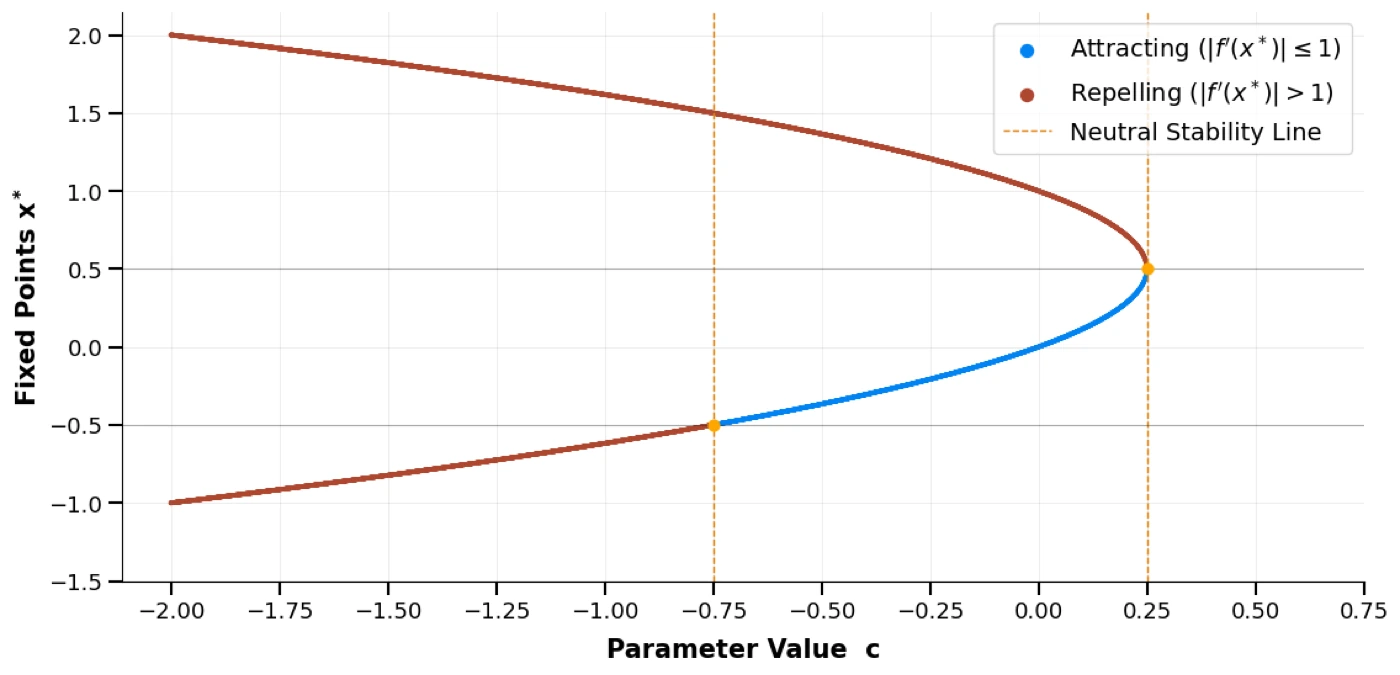
At
the fixed point loses stability. But the system does not immediately become chaotic. Instead, a stable orbit of period two appears. That is the first period doubling.
A cascade of doubling periods
The same transition then repeats. Period two gives way to period four, then eight, sixteen and thirty-two, while the intervals between successive bifurcations become rapidly smaller.
| Transition | c | Interval | Ratio |
|---|---|---|---|
| 1 → 2 | −0.7500 | 0.50000 | 4.23374 |
| 2 → 4 | −1.2500 | 0.11810 | 4.55151 |
| 4 → 8 | −1.3681 | 0.02595 | 4.64581 |
| 8 → 16 | −1.3940 | 0.00559 | 4.66394 |
| 16 → 32 | −1.3996 | 0.00120 | — |
The ratios approach the Feigenbaum constant,
Even with only the first few bifurcations, the fourth ratio is already within about 0.11% of the limiting value.
That is what makes the phenomenon interesting beyond this particular map. The same scaling appears across a much wider class of nonlinear systems undergoing period doubling.
The bifurcation points accumulate near
Beyond this accumulation point, the dynamics contain chaotic behaviour — but not chaos everywhere.
Stability returns inside chaos
The first bifurcations can still be handled analytically. Eventually the algebra becomes too cumbersome to remain useful, and numerical methods take over.
Those computations reveal something more interesting than a simple transition from order to permanent disorder. Around
a stable period-three orbit appears inside the chaotic region. It is created through a tangent bifurcation rather than another period doubling and remains stable over a finite interval of c.
So chaos is not a final uniform state. Stable periodic windows are embedded within it.
Period three is especially significant. For continuous interval maps, Sharkovskii’s theorem implies that the existence of a period-three orbit entails the existence of orbits of every positive integer period.
A remarkably simple map has therefore generated an extremely rich collection of possible behaviours.
Chaos does not mean escape
Unpredictable motion and unbounded motion are different things.
The final part of the paper studies which initial values remain bounded under repeated iteration. Once an orbit becomes sufficiently large, escape is guaranteed. For c ∈ [−2, 1/4], the radius
is enough. If |xₙ| > 2, then
Once the orbit leaves this boundary, its magnitude continues to grow and it cannot return.
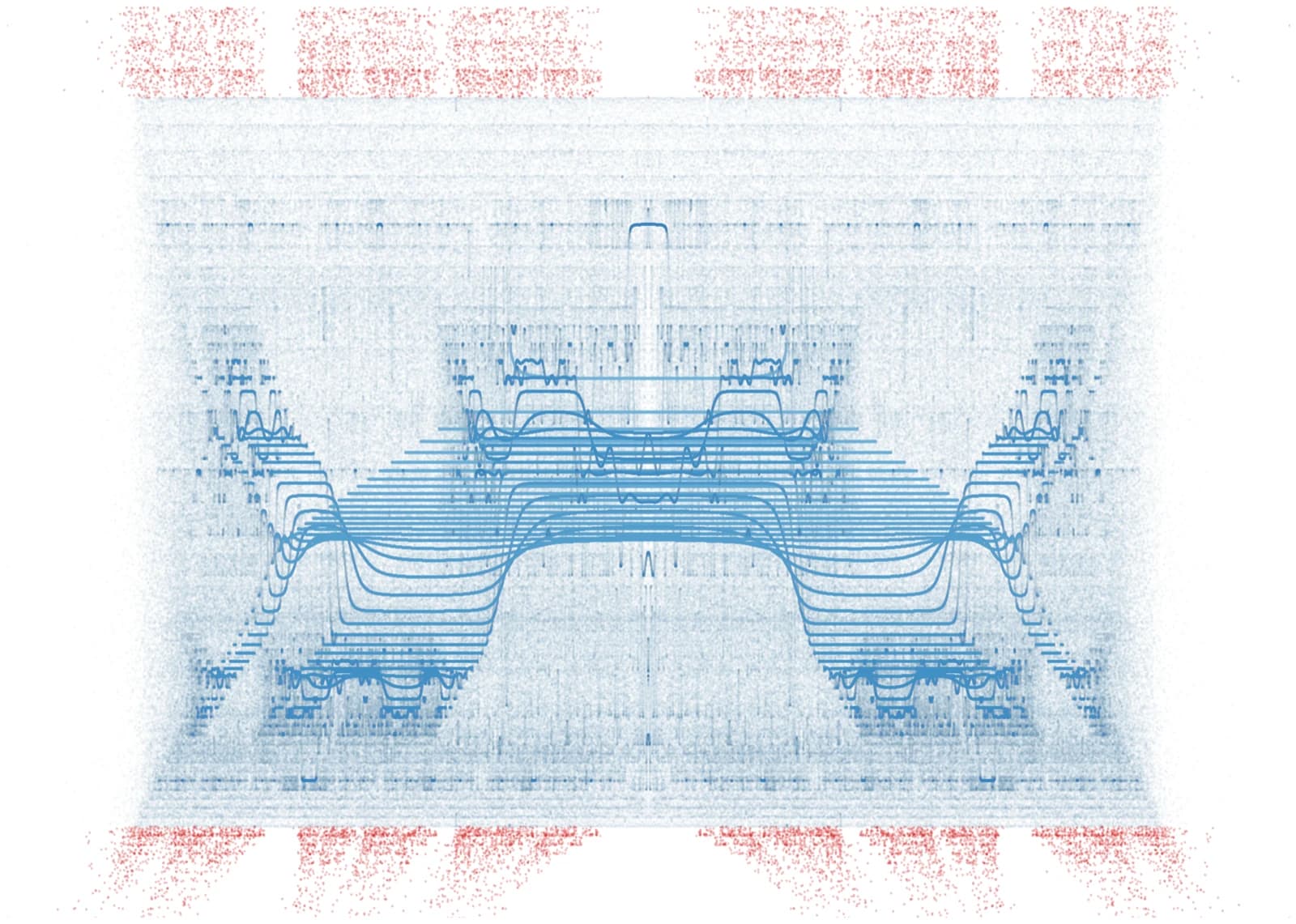
The bounded set survives far beyond the loss of the original stable fixed point. Within it lie period-doubling cascades, chaotic regions and periodic windows.
That distinction is the part of the system I find most striking:
Deterministic does not mean predictable, and chaotic does not mean unbounded.
Written for the course Programmeren en Experimenteren · BSc Mathematics · University of Amsterdam · February 2026.